The emergent future demands a shared data substrate...
Next-generation cognitive systems represent the long-awaited fulfillment of computing's promised vision.
They combine genuine machine intelligence with unified data models in place of scattered silos. They present adaptive multimodal interfaces, letting you engage the same substrate across every task and mode of interaction — chat, voice, symbolic manipulation, extended reality, etc., all expressions of the same underlying coherence. Most of all, they sustain a continuous relationship with your computing environment — an ongoing dialogue that fluidly shifts between capturing information, leveraging it, and shaping the system itself. If this reads as science fiction it is only because the enabling data foundation has, until now, been missing.
RELICA is that foundation.
A self-describing knowledge graph in which relationship semantics are defined within the graph itself. RELICA provides the integrated ontological substrate these cognitive systems require. It ships with foundational modeling capabilities — native temporal, spatial, and physical object semantics among them — so developers no longer need to construct core ontologies from scratch. And the model is fully addressable from conventional software: everything needed to read it, write it, and act on it comes included. You begin directly in your domain, mapping your problem space with RELICA's shared vocabulary and extending it as needed, benefiting from the accumulation of knowledge over time.
Because semantics live within the model itself, AI agents can read, reason about, and modify the graph's meaning structures.
This is what enables mutual competence over domains and sustained collaboration between human and machine intelligence — the defining characteristic of the next computing paradigm.
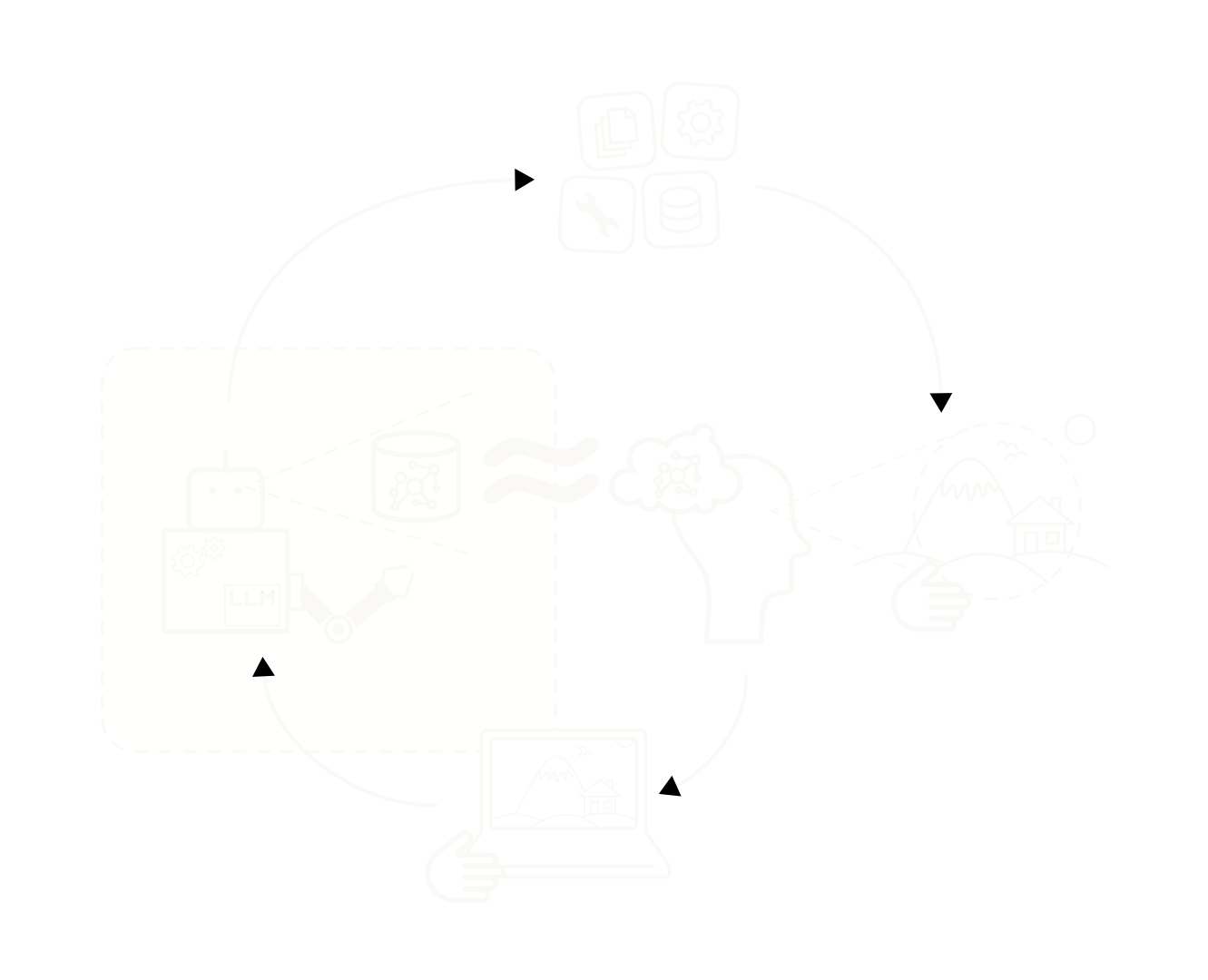
Continuous cognitive loop: human ↔ interface ↔ AI ↔ semantic model ↔ world
Expression begets experience.
Meaning, carried both ways
Every layer transforms in two directions — application shape pushed down into atomic facts, facts pulled back up into shape.
query language: Read facts by pattern — the query surface over the raw graph.
method runtime: Graph-borne entity dynamics — methods live on entities as graph operations, read and write.
view system: Abstract, declarative presentation paired to method-read data.
semantic lens: Pull a fact constellation into client shape; push edits back into facts.
New foundations raise new possibilities
Integrated information modeling lays the groundwork for myriad new possibilities...
a personal information model
Resuming the stalled project of the personal computer...
When information is integrated into one model, a person's world — projects, people, tasks, goals — can be addressed as one system. On that model, builders can raise assistants that inhabit your context, instead of re-learning it at every interaction or holding scattered data models together, over and over.
Animated diagram: a lens browses a small example information model for this chapter, visiting facts such as “you focuses on launch” and showing the roles and kinds involved in each relation.
a business information model
The business is one system. Model it that way...
A business is interconnected in reality — clients, commitments, assets, decisions — but its data lives in forty apps that aren't. Today, people and software spend real effort at doing-time just holding that picture together. Unify it into one integrated information model, give AI clean paths to read and write it, and those cycles go back to the work: the baseline of what a system can do rises — for a studio of two, a firm of two thousand, and everything after.
Animated diagram: a lens browses a small example information model for this chapter, visiting facts such as “retainer commits studio” and showing the roles and kinds involved in each relation.
a narrative information model
The groundwork for a new storytelling medium...
When integrated information can model places and objects, characters — their interactions, their internal states — and the dynamics of all of it over time, then a story's events and its telling — fabula and syuzhet — can be modeled in cross-reference. AI agents can manipulate that structure procedurally; game engines and visualization systems can render it. Close that loop and a new storytelling medium opens — dynamic like a game, deep like a film — for authors to discover.
Animated diagram: a lens browses a small example information model for this chapter, visiting facts such as “elena believes map” and showing the roles and kinds involved in each relation.
...reifying the potential of contemporary neuro-symbolic AI.
View the roadmap→
Follow the build
Occasional updates as RELICA approaches release — and early access when it arrives. No spam, ever.